The Broward Clerk of Court records system stores official case filings, court documents, and legal entries for the Broward County, FL Courts. The Broward County Clerk of Court, Fort Lauderdale, FL, maintains this system as the central court clerk office responsible for organizing civil, criminal, family, and traffic case records in a structured legal registry. Each record reflects formal court activity linked to filings and case processing within the county court system.
Records exist to maintain a verified history of every legal matter handled through Broward County, FL Courts. The court clerk’s office records filings, judgments, and case actions so each entry stays properly documented in the legal registry. Courts handle hearings and decisions, while the clerk’s office preserves each step as an official record. This connection keeps case information organized, traceable, and consistent across all court divisions in Broward County.
What Is the Broward Clerk of Court?
The Broward Clerk of Court serves as the official record keeper for court documents and legal filings in Broward County. The office supports the court system by managing records, filings, and public legal information for cases handled in the county.
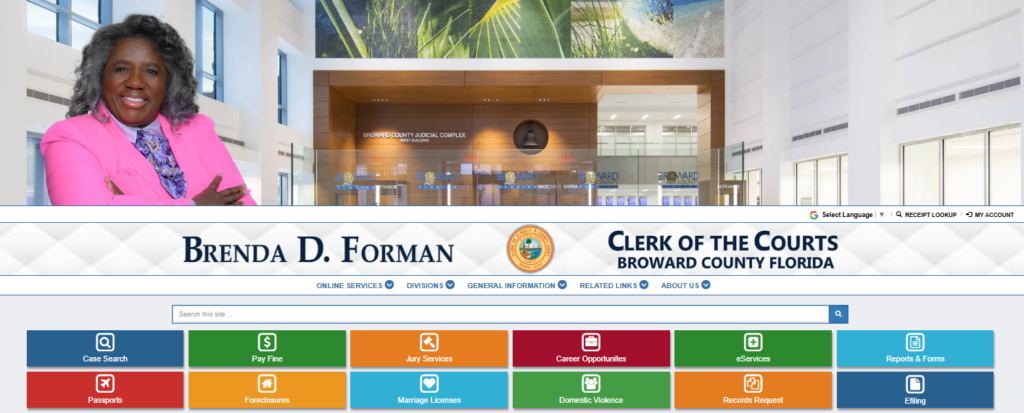
The Broward County Clerk of Court, Fort Lauderdale, FL, operates as a central administrative office connected to the judicial system, but it does not decide case outcomes or issue rulings. The office is led by an elected official who oversees court record management and daily administrative operations across the county court system. As of recent records, the position is held by Brenda D. Forman, who serves as the elected Clerk of Court for Broward County.
Role of Broward Clerk of Court in the Legal System
The Clerk of Court acts as the administrative center for court-related records in Broward County. It works as a court clerk’s office that organizes, stores, and processes legal documents submitted during civil, criminal, family, and traffic cases. This office functions as a legal registry for the county. Every case filed in court generates records that pass through the clerk’s system. These records include petitions, motions, judgments, and hearing schedules.
Functions include:
- Filing legal documents for court cases
- Recording official case activity
- Managing case dockets and schedules
- Issuing certified copies of records
- Handling fees linked to filings
The clerk does not act as a judge or legal authority on disputes. It only manages documentation tied to court activity. This separation keeps records organized and publicly available through official systems.
Administrative Responsibilities and Court Records Management
The Broward Clerk of Court handles a wide range of administrative duties that support daily court operations. It maintains structured records for both public and confidential case files, depending on legal requirements.
Core responsibilities include:
- Processing new case filings in civil and criminal matters
- Maintaining electronic and physical court records
- Managing jury services and summons processing
- Collecting court-related fees and payments
- Updating case status in official systems
The office also maintains a public record database that includes case information, docket entries, and hearing updates. This system allows legal professionals, researchers, and the public to review court-related data within permitted access levels.
Clerk of Court vs Court
The court and the clerk’s office serve separate functions within the judicial system. The court focuses on case decisions, while the clerk handles documentation and record maintenance. The court includes judges who hear arguments, review evidence, and issue rulings. In contrast, the clerk’s office does not participate in decision-making. It acts as the administrative record system for everything that occurs in court.
Differences:
- Court: Issues rulings, conducts hearings, decides outcomes
- Clerk of Court: Maintains records, files documents, processes case paperwork
- Court staff: Focus on legal judgment and proceedings
- Clerk staff: Focus on documentation, scheduling, and record accuracy
The Broward County Clerk of Court, Fort Lauderdale, FL, works closely with the judiciary but remains separate in authority. Judges depend on accurate records maintained by the clerk’s office to manage hearings and case flow.
How to Search Broward Court Records
Broward court records are searched through an official case lookup system managed by the Broward County Clerk of Court in Fort Lauderdale, FL. This system lets users review public case details from Broward County, FL, https://www.browardclerk.org/, courts using case numbers, names, or filing dates. The legal registry stores civil, criminal, traffic, and family case information. Searches depend on correct input and proper filters within the document filing database.
Case Number Search Method in Broward Court Records
Case number search is the most precise method in the Broward County Clerk of Court, Fort Lauderdale, FL system. Each case receives a unique identifier during filing, which connects directly to the record. This method is often used by attorneys, law offices, and users who already have case details.
Steps used in the case number lookup system:
- Enter the full case number exactly as recorded
- Select the correct case type (civil, criminal, traffic, family)
- Review the matching record from the Broward County, FL, courts database
- Open docket summary for filings and updates
Case number search reduces confusion because it bypasses name variations and duplicate entries in the legal registry.
Name-Based Search in Broward County, FL Courts
Name-based search is used when a case number is not available. The Broward County Clerk of Courts system allows searches using party names, which pull records linked to individuals or businesses.
Common name search inputs include:
- Full legal name (first, middle, last)
- Partial name entries
- Business or organization names
- Alternate name variations
Search results may show multiple entries when names are common. The legal registry may list several matching cases across civil and criminal sections.
Date Filtering and Court Division Selection
Date filtering helps narrow results within the document filing system. The Broward County Clerk of Court, Fort Lauderdale, FL, platform allows users to set filing ranges to refine results. Court division selection further separates records based on case type.
Common filtering options include:
- Filing date range (start and end dates)
- Court division (civil, criminal, family, traffic)
- Case status (open, closed, inactive)
These filters help reduce large result lists in the legal registry. They are useful when multiple cases share similar names or filing types.
For example:
- Civil disputes appear under the civil division
- Arrest-related records appear under the criminal division
- Traffic violations appear under the traffic division
This structure keeps Broward County, FL, courts’ records organized within the case lookup system.
Broward County Clerk of Court, Fort Lauderdale, FL System Role
The Broward County Clerk of Courts, Fort Lauderdale, FL, system works as the official document filing hub for all court records. It stores and organizes case data from multiple court levels within Broward County, FL courts.
This system functions as a legal registry that records:
- Case filings and amendments
- Hearing schedules
- Judgments and orders
- Public case summaries
The case lookup system is built to pull real-time updates from the filing database. Each record reflects updates submitted by court staff, attorneys, or authorized filers.
Broward County Courts and Judicial Structure
The Broward County court system operates within Florida’s judicial system and handles civil, criminal, family, and traffic-related matters. The structure follows a clear court hierarchy where different courts handle specific types of cases under the broward county fl courts network. Cases in Broward County move through a structured legal framework where circuit courts handle major matters and county courts manage lower-level disputes. In certain criminal cases, reports and findings from the Medical Examiner may also become part of the evidentiary record used during legal proceedings. The system also relies on the Clerk of Court for recordkeeping, filings, and public case information within this judicial system.
Circuit Court Structure within Broward County
The circuit court sits at a higher level in the local court hierarchy and manages serious legal matters under the Florida judicial system. In Broward County, this court operates within the 17th Judicial Circuit and handles complex case categories. The circuit court structure covers cases that require broader legal authority and formal procedures. It works alongside county courts but handles cases with higher stakes or wider legal impact.
Case types handled at this level include:
- Major criminal cases, such as felonies
- High-value civil disputes
- Family law matters like divorce and custody
- Probate and estate-related cases
The circuit court plays a central role in maintaining the legal framework of Broward County. Judges at this level interpret laws and apply them to serious disputes. Case filings, scheduling, and official records are processed through the Clerk of Court system.
Civil vs Criminal Courts in Broward County
The Broward County, FL, court system separates civil and criminal matters to maintain organized case handling. Each category follows different procedures and legal standards within the judicial system. Civil courts deal with disputes between parties where no criminal charge exists. Criminal courts handle cases where the state prosecutes an individual or group for alleged violations of law.
Civil Court Cases
Civil courts in Broward County commonly manage:
- Contract disputes
- Property disagreements
- Personal injury claims
- Landlord and tenant issues
These cases usually focus on financial compensation or legal resolution between parties.
Criminal Court Cases
Criminal courts handle:
- Misdemeanors, such as minor offenses
- Felonies involving serious charges
- Traffic-related criminal violations
- State prosecution cases
The criminal process involves law enforcement, prosecutors, and defense representation under formal court procedures.
Clerk’s Role in the Broward County Legal Framework
The Clerk of Court functions as a central administrative authority within the Broward County court system. This office supports both civil and criminal divisions by managing official records and court documentation.
Responsibilities include:
- Filing legal documents submitted to courts
- Maintaining case records within the legal framework
- Processing court fees and related payments
- Providing public case information from court databases
| Area of Support | Function |
|---|---|
| Case Records | Stores civil and criminal case files |
| Court Filings | Receives and processes legal documents |
| Public Records | Provides case information for review |
| Administrative Support | Assists court operations and scheduling |
The Clerk’s office connects different levels of the court hierarchy, supporting judges, attorneys, and the public record system.
Clerk of Court Services
The Broward County Clerk of Court handles official court paperwork, public records, and financial transactions tied to legal cases in Fort Lauderdale, Florida. It works as the central record authority for filings, licenses, and court-related documentation within the county. The office supports both residents and legal professionals through structured record management and public service functions.
Document Filing System at Broward County Clerk of Court, Fort Lauderdale, FL
The document filing system at the Broward County Clerk of Courts, Fort Lauderdale, FL, operates as the main legal registry where court-related paperwork is submitted, recorded, and organized for civil, criminal, family, and traffic cases. This system processes filings such as complaints, motions, petitions, and judgments, ensuring each document is linked to a specific case number within the court database. Both paper submissions and electronic filings are handled through structured workflows that maintain accuracy and traceability across all legal records. The system also supports public records management by storing legal documents in a way that allows authorized retrieval when needed for case review, legal verification, or administrative purposes. Through this structured document filing process, the clerk’s office maintains a consistent legal record system that supports court operations across Broward County.
Marriage License Processing and Records
Marriage license services form a key function within the clerk of court operations. These records confirm legal authorization for marriage within the county. Applicants submit identification, fill required forms, and complete processing at designated clerk service locations. Once approved, a marriage license is issued and recorded in the county database.
Marriage record services include:
- Issuance of marriage licenses
- Recording of completed marriage certificates
- Verification of marriage registration details
- Maintenance of historical marriage documents
The system stores these records within the public records system for future reference and legal verification. Marriage documentation remains part of the permanent legal registry maintained by the county office.
Official Records and Public Records System
The official records system managed by the clerk of court includes a wide range of legal and administrative documents maintained within Broward County. This public records system stores property deeds, liens, mortgage documents, civil case records, and business filings that fall under county jurisdiction. Each record is indexed within a structured legal registry that connects documents to case identifiers or property references, allowing organized retrieval when needed for verification or research purposes. The system supports transparency in record keeping by maintaining historical and current documents in a centralized archive. Residents, attorneys, and organizations often rely on these official records for property confirmation, legal reference, and background documentation within Broward County’s court record framework.
Court Fee Payments and Transaction Processing
Court fee payment processing within the clerk of court system handles financial transactions related to legal filings, court cases, and administrative services. Payments include filing fees, traffic fines, certification charges, and other court-related costs that are recorded directly within the case management system. Each transaction is linked to a specific case file, allowing accurate financial tracking and record consistency across the legal registry. The system supports both in-person payments and electronic processing methods, ensuring flexibility in how fees are submitted and recorded. These financial records remain part of the broader public records structure, helping maintain clear documentation of all court-related transactions within Broward County’s administrative system.
Court Locations in Broward County
Broward County has multiple courthouse locations that serve different judicial needs across the region. These Broward County, FL, courts operate as key judicial centers for civil, criminal, probate, and family-related matters. Each courthouse location supports public services based on jurisdiction and case type. The courthouse locations are positioned in major cities to make legal services more organized across the county. The three primary judicial centers include Fort Lauderdale, Plantation, and Hollywood.
Fort Lauderdale Courthouse
The Fort Lauderdale courthouse is the main judicial center in Broward County. It handles a wide range of court operations and serves as the central hub for county-level filings. This location is part of the core judicial system infrastructure in Broward County. It supports both high-volume case processing and administrative court functions.
Functions at this courthouse include:
- Criminal case hearings and arraignments
- Civil dispute processing
- Probate and estate matters
- Family-related filings and hearings
- Clerk of court record processing
This courthouse also handles many public records requests through the Broward Clerk of Court system. It remains one of the busiest judicial centers in the county.
Plantation Courthouse
The Plantation courthouse serves the western region of Broward County. It supports residents and legal professionals with scheduled hearings and administrative court matters. This location helps reduce congestion at the main Fort Lauderdale facility by handling selected case categories.
Services commonly handled here include:
- Family court hearings
- Traffic-related hearings
- Selected civil case proceedings
- Small claims matters
- Clerk-managed document services
The Plantation courthouse plays a steady role in distributing court workload across Broward County, FL, courts, improving case flow across judicial centers.
Hollywood Courthouse
The Hollywood courthouse serves the southern section of Broward County. It operates as a local judicial center for both civil and criminal matters. This courthouse supports nearby communities with accessible court-related services without traveling to Fort Lauderdale.
Main functions include:
- Criminal preliminary hearings
- Civil case filings
- Traffic court sessions
- Local record processing
- Court clerk assistance services
It functions as an important part of the courthouse locations network, supporting regional legal processing.
FAQs About Broward Clerk of Court
The Broward Clerk of Court maintains court records, case filings, and official documents connected to county legal matters. These FAQs explain how court records work within the Broward court system, in the FAQ context, and how the legal registry retrieval system operates for public information.
Is the clerk of the court the same as the court?
The Clerk of Court is not the same body as the court itself. The court handles hearings, rulings, and legal decisions in Broward County. The clerk works on record handling and case paperwork management. This office stores filings, maintains case histories, and organizes official documents. Judges decide outcomes, while the clerk maintains the legal record system.
How to access records?
Court records are listed through the official Broward County record system. Searches are usually done using a case number or party name tied to a filing. The system shows case details, hearing notes, and document entries. Users may also review docket activity linked to civil or criminal matters. Some files may require additional steps if they are older or stored in an archived form.
Are court records public?
Most court records in Broward County are open for public viewing under Florida law. These records include civil cases, criminal filings, and routine court paperwork. Certain case types remain restricted by law, such as juvenile matters and sealed files. Family law cases may also have limited details shown in public listings. Public record availability supports transparency in the court record system FAQ structure.
How long do updates take?
Record updates vary based on filing type and case volume in the system. New filings often appear within one to two days after processing. Some document updates may take several business days before showing changes. Older cases stored in archives may take longer to reflect updates. Processing speed depends on the workload within the Broward court record system.
Can certified copies of court records be obtained?
Certified copies of court records can be requested through the Broward Clerk of Court’s office. These copies carry official verification and are often used for legal, employment, or immigration purposes. Requests usually require case details, such as a name or case number, to locate the file. Fees may apply depending on the number of pages and document type. Processing time varies based on workload and record availability in the legal registry system.